
Wednesday's Wildlife: Great Horned Owl

A deep, unmistakable hoot echoes through the trees on a quiet evening. Somewhere nearby, one of Alberta's most formidable predators is making its presence known. With its piercing yellow eyes, prominent feather tufts and powerful build, the Great Horned Owl (Bubo virginianus) is one of North America's most recognisable birds of prey. It's also Alberta's official provincial bird, a title it has held since 1977, when schoolchildren across the province voted to give it the honour.

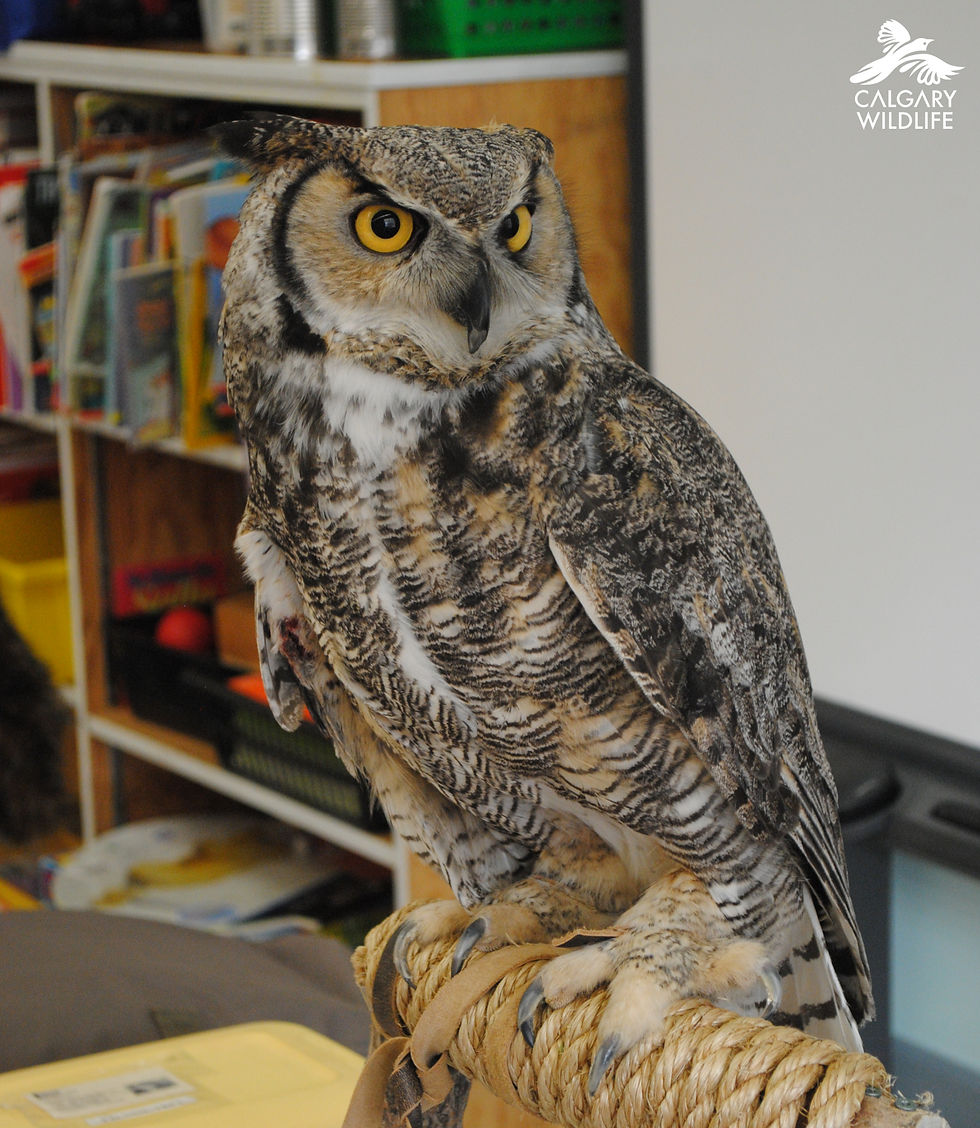
Despite its name, the Great Horned Owl doesn't actually have horns! The distinctive tufts of feathers on top of its head are called plumicorns, and although they resemble ears, they have nothing to do with hearing. Their exact function is still debated, but researchers believe they may play a role in communication or camouflage. The owl's actual ears are hidden beneath feathers on the sides of its head. Its mottled brown and grey plumage, barred underside and pale throat patch give it a distinctive appearance while helping it blend into its surroundings.
Great Horned Owls are large, powerful birds, measuring approximately 46 - 63 cm in length, with wingspans reaching 1.45 metres. Females are generally larger than males, although both sexes look very similar. Like other owls, their large, forward-facing eyes provide excellent vision in low light. However, their eyes cannot move within their sockets the way ours do. Instead, owls can rotate their heads up to approximately 270 degrees to look around. Their rounded facial discs also help direct sound toward their ears, giving them remarkable hearing.

A master of many habitats
Great Horned Owls are highly adaptable birds. Their preferred landscapes generally combine wooded areas for nesting and roosting with open areas where prey is easier to locate. Open fields and pasture can provide important hunting grounds even when they are not suitable nesting habitat themselves.
This flexibility helps explain why Great Horned Owls can thrive close to people. They may establish territories in wooded parks, suburban areas, river valleys and other landscapes where suitable trees and abundant prey remain available. They are generally tolerant of habitat changes as long as adequate nesting sites and food remain.
Great Horned Owls are also year-round residents in Alberta rather than migratory visitors. Their adaptations to cold weather, including exceptionally soft, insulating feathers, allow them to remain active through Alberta winters.

An impressive and varied diet
Great Horned Owls are formidable predators with one of the broadest diets of any North American raptor. They primarily eat mammals and birds, but their menu can include reptiles, amphibians, fish, insects and other invertebrates. Depending on what is available locally, they may hunt mice, voles, rats, squirrels, gophers, rabbits and hares, as well as ducks, geese, coots, crows and other birds. They are even capable of killing other raptors, including hawks, falcons and owls.
In Alberta, this adaptable diet allows them to take advantage of changing prey populations and different habitats. An owl hunting along a woodland edge may target a mouse or vole, while another hunting near open agricultural land might pursue a rabbit or larger bird.
Great Horned Owls are primarily nocturnal hunters. They often sit quietly on a perch and watch or listen for prey before swooping down to capture it. Their broad, rounded wings and specialised feathers allow them to fly with remarkably little sound, giving prey little warning of an approaching attack. Their large eyes and highly sensitive hearing further enhance their ability to hunt in low light.

Love, hoots and borrowed nests
Great Horned Owls typically form monogamous breeding pairs, with both parents contributing to raising their young. Courtship includes vocalisations and displays, and pairs may call together in a distinctive duet. The male's deeper voice contrasts with the female's higher-pitched call. Pairs defend breeding territories with vigorous hooting, particularly during the period leading up to egg-laying.
One of the most remarkable things about Great Horned Owl reproduction is that these owls generally do not build their own nests. Instead, they frequently take over abandoned nests built by other birds, including hawks, crows, ravens and herons. They may also use tree cavities, cliff ledges, buildings, artificial platforms or other suitable sites. The availability of appropriate nesting locations is therefore an important factor in their ability to occupy an area.
Great Horned Owls are early breeders, with nesting beginning surprisingly early in the year. In southern Alberta, breeding can begin as early as late January or February. Females typically lay between one and four eggs, which are incubated for approximately 30–37 days. The young remain dependent on their parents after hatching and spend roughly six weeks or more developing before they become capable fliers.
The parents have different but complementary roles during this demanding period. The female spends considerable time incubating and protecting the young, while the male commonly provides much of the food. Both parents defend the nest and eventually help provision their growing offspring.

Who preys on a Great Horned Owl?
An adult Great Horned Owl sits near the top of the food web, and healthy adults have relatively few natural predators. Their powerful talons, large size and aggressive territorial behaviour make them dangerous prey for most other animals. However, their eggs and young are much more vulnerable.
Unattended eggs and nestlings may be attacked by crows, ravens, raccoons, foxes, coyotes, lynx and other raptors. Crows and ravens also frequently mob adult Great Horned Owls, loudly harassing and dive-bombing them during daylight hours. Outdoor domestic cats are also significant risks for Great Horned Owl owlets.
Great Horned Owls themselves are important predators within Alberta ecosystems. Their ability to consume rodents, rabbits and other animals helps regulate prey populations, while their presence can indicate that a landscape continues to provide suitable habitat and food resources.

Human-related threats
Although Great Horned Owls remain widespread and are considered secure in Alberta, human activity can still pose serious risks to individual birds and, in some circumstances, to populations.
Habitat loss and fragmentation can reduce the availability of suitable nesting trees and productive hunting areas. Fortunately, Great Horned Owls are more adaptable than many other owl species, and they can continue to use modified landscapes when sufficient nesting sites and prey remain available.
Collisions and entanglement are another concern, particularly in urban environments. Calgary Wildlife previously rehabilitated a Great Horned Owl that became trapped in netting beneath a busy city intersection. The owl sustained injuries but was successfully rehabilitated and released. Such incidents illustrate how infrastructure intended for human purposes can unintentionally become a hazard for wildlife.

Rodenticides pose another significant risk because Great Horned Owls may consume poisoned rodents. A British Columbia government review found widespread rodenticide exposure among sampled Great Horned Owls and identified secondary poisoning—where a predator consumes a poisoned animal—as a potential conservation concern. The reasearch also suggested that Great Horned Owls can be exposed to multiple anticoagulant rodenticides through their prey.
Historically, Great Horned Owls were also persecuted because people believed they threatened poultry and other domestic animals. Although legal protection has reduced this threat, illegal shooting still occurs.

Great Horned Owls at Calgary Wildlife
At Calgary Wildlife, we regularly admit Great Horned Owls for a variety of reasons, including injuries, poisoning and orphaning. Unfortunately, many of these admissions are related to human activity. Young owls may be orphaned when nests are damaged or disturbed, and repeated human presence near nesting sites, including wildlife photographers getting too close, can sometimes cause parents to abandon their nests. However, not every young owl found outside its nest is orphaned! Great Horned Owl fledglings often leave the nest before they can fly properly, and their parents typically continue caring for them nearby.
Vehicle collisions are another significant concern. As ambush predators, Great Horned Owls often perch quietly and wait for prey before swooping down to capture it. Roadsides can provide attractive hunting grounds, with mice, voles and other small mammals drawn to grassy ditches and vegetation. Fence posts, signs and utility poles also provide convenient hunting perches. Unfortunately, when an owl swoops low across a road in pursuit of prey, it can fly directly into the path of an oncoming vehicle. We also see owls affected by rodenticides, which can poison predators when they consume contaminated prey.
Not every owl that arrives at our facility can return to the wild. Ophelia, our resident Great Horned Owl, came to Calgary Wildlife in 2007 with a broken wing. Although her fracture healed, scar tissue prevented her from performing the precise aerial manoeuvres needed to hunt successfully. Unable to survive independently in the wild, Ophelia became one of our education ambassadors, helping thousands of Calgarians learn about owls and coexistence with wildlife. She retired from education programs in 2023 and continues to enjoy a peaceful retirement at our facility.
Sharing Alberta with Great Horned Owls
Great Horned Owls have proven remarkably capable of living alongside people, but coexistence works best when their needs are respected. Protecting mature trees and suitable nesting habitat, reducing opportunities for entanglement, and using rodent-control methods that do not poison wildlife can all help reduce human-caused risks.
For anyone lucky enough to encounter one, the best approach is simple: observe from a respectful distance and allow the owl to go about its business. During nesting season, adults can be fiercely defensive of their young. Young owls may also spend time on the ground while learning to fly, and their parents are often nearby. If an owl appears injured or genuinely in distress, contacting a qualified wildlife rehabilitator is safer for both the bird and the person attempting to help.
The Great Horned Owl's ability to hunt, adapt and survive Alberta's challenging seasons makes it an impressive symbol of the province's wildlife. From a quiet river valley to a wooded Calgary neighbourhood, hearing that unmistakable series of deep hoots after sunset is a reminder that one of North America's most powerful nocturnal predators may be living surprisingly close by.
For assistance with injured and orphaned wildlife, please contact the Calgary Wildlife Rehabilitation Society at 403-214-1312.


