
Wednesday's Wildlife: Western Painted Turtle

On the right summer day, Alberta's wetlands can offer something most people never expect to see here: a turtle. Western painted turtles are Alberta’s only native turtle species. They're quiet, cautious, and easy to miss. They’re tucked into a few warm pockets of the province where wetlands and slow-moving waters give them what they need to survive.
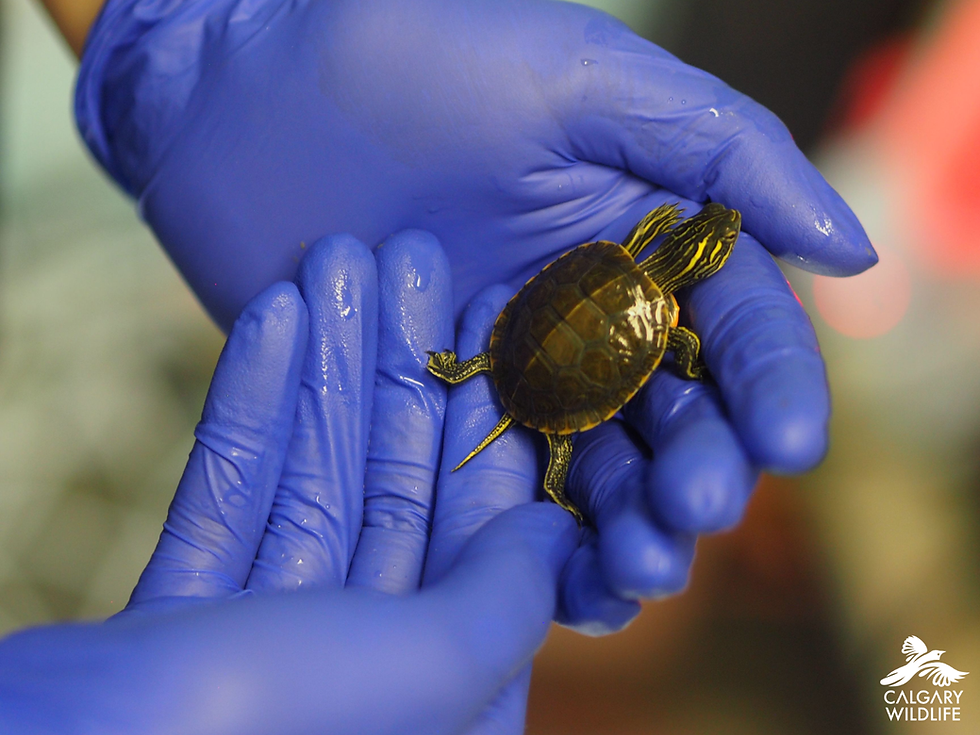
Western painted turtles (Chrysemys picta bellii) are a subspecies of the painted turtle, and they earn their name honestly. Up close, they appear as if they walked straight out of an artist's studio: thin yellow stripes along the head and neck, and warm reds and oranges tracing the edges of the shell. Even the underside of the shell, known as the plastron, is decorated with contrasting bright orange and black markings. The reason for this colouration is not fully understood. Females tend to be more brightly coloured than the males, suggesting their colours may have something to do with sexual selection. However, other hypotheses for their colouration include predator deterrence, immune function signalling, and intraspecific signaling (Jaimes et al., 2025). What is certain is that these turtles are striking, brightly patterned against the greens, browns, and blues of their wetland world.

Western painted turtles are built for a slow, steady life. Adults can reach about 25cm in shell length and may live for decades. They spend most of their time in the water, feeding on a mix of aquatic insects, snails, carrion, and plant material, then haul out to bask when the sun cooperates. Because they’re reptiles, they rely on external heat to regulate their body temperature, helping them warm up for digestion, movement, and overall health. If you ever spot a “pile” of turtles stacked like pancakes on a log, you’re seeing a warm, safe resting spot in high demand (COSEWIC, 2012).
In winter, western painted turtles pull off a survival trick that feels almost unbelievable. Instead of heading to a den on land, adults and juveniles settle into dormancy underwater, resting on the muddy bottom of ponds or tucking into shelter like muskrat burrows. They can stay in the same small area all winter, even when the water above them is ice-covered. While they’re hibernating, their bodies slow down so much that they need far less oxygen. They can take in some oxygen directly from the water through parts of their body, but not enough to power them all winter. So they switch to a backup plan: they run on stored energy in a way that doesn’t require much oxygen. As that process creates built-up waste in the body, their shell helps buffer it, basically acting like a built-in support system that keeps them stable until spring. Painted turtles are described as the most tolerant turtle species in Canada for these low-oxygen winter conditions, and western painted turtles are noted as especially well suited to long northern winters (COSEWIC, 2012).

Alberta is right at the edge of where western painted turtles can make a living, and the result is a range that’s tiny compared to most of North America. Here, they’re known only from a few warm pockets in the far south of the province, including the Cypress Hills region, the lower Milk River area, and parts of the Oldman River basin. Alberta’s Wild Species Status Search classifies them as Sensitive and estimates there are probably fewer than 100 individuals in the province (Government of Alberta, "Wild Species Status Search", n.d.). In Alberta, rarity is part of the western painted turtle’s reality, and that shapes how the species is assessed and managed.
This is where the “are they endangered?” question gets messy because the answer changes depending on which list you’re looking at and which population you mean. In Alberta, the provincial status system currently ranks the western painted turtle as Sensitive, reflecting how rare and localized it is here (Government of Alberta, 2020). Nationally, COSEWIC doesn’t treat western painted turtles as one single Canadian population; it assesses three regional populations with different outcomes: the Prairie/Western Boreal–Canadian Shield population (which includes Alberta) is assessed as Not at Risk, while the Intermountain–Rocky Mountain population is Special Concern, and the Pacific Coast population is Threatened and listed under the Species at Risk Act (COSEWIC, 2016; Government of Canada, n.d.). Globally, painted turtles are considered Least Concern on the IUCN Red List, (IUCN, 2011) so the same animal can be broadly secure overall, while still being a real conservation concern in specific regions.
While the turtles in Alberta are not considered endangered, that doesn't mean that they don't face any threats. . Across Canada, habitat loss, alteration, and fragmentation continue to drive local declines in western painted turtles. Wetlands can be drained, infilled, or degraded by development and agriculture, and even free-ranging cattle can trample shorelines and muddy up the shallow water areas these turtles rely on. Additionally, road mortality can be a serious issue where wetlands and road networks overlap. The risk of vehicle collisions spikes during the nesting season, when females leave the water to dig nests on land (COSEWIC, 2012; COSEWIC, 2016).

Layered over all of this is a distinctly human pressure: turtles taken into captivity or released from the pet trade can disrupt local populations, muddy the picture of where turtles “belong,” and introduce risks that wild turtles are poorly equipped to handle. In Alberta, that concern is reflected directly in the law. Western painted turtles are wildlife, and most wildlife in Alberta cannot be legally kept as pets. The province restricts possession of live wildlife to people and organizations operating under specific permits, such as accredited zoos or approved research facilities (Government of Alberta, "Wildlife as pets", n.d.). In practical terms, that means a western painted turtle generally cannot be legally owned as a household pet.
The reasons behind those rules are grounded in animal welfare and conservation. Taking a turtle from the wild removes a breeding individual from an already small, localized population. Releasing a pet turtle back into the wild isn’t a solution either. Turtles kept in captivity may carry diseases or parasites that wild populations have never been exposed to, and even healthy-looking animals may lack the skills needed to survive Alberta’s climate, predators, and seasonal cycles. Released turtles can also end up in places where turtles don’t naturally occur, creating confusion for conservation efforts and putting pressure on habitats that aren’t equipped to support them (COSEWIC, 2016). In short, whether it’s taking a turtle home or letting one go later, both actions can cause real harm, which is why Alberta’s approach is to keep wild turtles wild.
At the end of 2025, Calgary Wildlife welcomed two western painted turtles who had been impacted by the pet trade. Jane and Reginold (or “Reggie”) came into care from situations where living as pets meant they never developed the skills needed to survive in the wild. While western painted turtles may appear hardy, life in captivity often changes how they respond to people, predators, and seasonal cues, making release unsafe for both the turtle and the ecosystem it would be returning to.

Jane and Reggie now have a permanent home with Calgary Wildlife as education ambassador animals. Jane is the larger, more brightly coloured of the two, while Reggie is smaller and typically duller in colouration, which is common for males. What Reggie lacks in size, he makes up for in confidence: he’s curious, people-motivated, and often the first to swim up to the glass when someone approaches. Together, they help illustrate why turtles aren’t suitable pets, and how education ambassadors can play an important role in helping people understand wetlands, reptiles, and what it truly means to coexist with wildlife.
Western painted turtles don’t ask for much: warm shallows, quiet wetlands, and the chance to be left alone to do turtle things. In Alberta, giving them that space means paying attention, keeping wildlife wild, and appreciating the small, slow stories happening just below the water’s surface.
For assistance with injured wildlife, please contact the Calgary Wildlife Rehabilitation Society at 403-214-1312.
References:
Committee on the Status of Endangered Wildlife in Canada (COSEWIC). (2012). Western painted turtle (Chrysemys picta bellii): COSEWIC assessment and status report 2012. Environment and Climate Change Canada.
Committee on the Status of Endangered Wildlife in Canada (COSEWIC). (2016). Western painted turtle (Chrysemys picta bellii): COSEWIC assessment and status report 2016. Environment and Climate Change Canada.
Government of Alberta. (n.d.). Wild Species Status Search: Western painted turtle.
Government of Alberta. (n.d.). Wildlife as pets.
Government of Alberta. (2020). Reptiles: Detailed finding (Fish and wildlife indicators).
Government of Canada. (n.d.). Species at Risk Act: Schedule 1. Justice Laws Website.
International Union for Conservation of Nature (IUCN). (2011). Chrysemys picta. The IUCN Red List of Threatened Species.
Jaimes, G., Maki, E., & Reinke, B. A. (2025). Assessing the impact of environment on the color of painted turtles (Chrysemys picta) in the wild. Ecology and Evolution, 15(7), e71702. doi:10.1002/ece3.71702


